Frédérick Madore, PhD
Historian of Islam in francophone West Africa and digital humanist · Data Curator and Researcher, University of Bayreuth
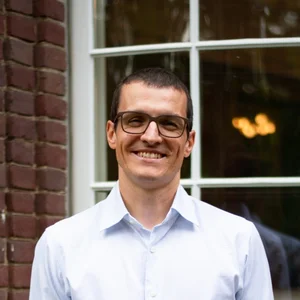
I am a historian and digital humanist at the University of Bayreuth (Germany). I study Islam in francophone West Africa, and I build open collections, AI workflows, and research infrastructure that let me read its sources in new ways.
My two roles feed each other. At the Cluster of Excellence “Africa Multiple”(opens in new tab), I am Data Curator(opens in new tab) and a researcher in the Research Section Digitalities(opens in new tab). As curator, I help design the systems that make research data findable and reusable under the FAIR and CARE principles, and I work with colleagues on the digital literacy and ethical standards that curation demands. As Co-Principal Investigator of Islam’s ‘Peripheries’ (2026–2028), a Volkswagen Foundation project with Aksana Ismailbekova, I use AI to compare Islamic discourse in two multilingual collections, from West Africa and Central Asia. The project also tests new ways into them, from searching across languages to querying them in plain language through an AI assistant, with open-source tools that researchers in both regions can use.
My research draws on fifteen years of work on Islam in francophone West Africa and extensive fieldwork in the region. It examines how Muslim communities, particularly youth and women, have engaged with politics, education, and the public sphere in Benin, Burkina Faso, Côte d’Ivoire, and Togo since the 1960s. Before Bayreuth, I was a Research Fellow at Leibniz-Zentrum Moderner Orient (ZMO)(opens in new tab) in Berlin, and before that a Banting Postdoctoral Fellow(opens in new tab) at the University of Florida(opens in new tab).
Digital humanities and AI in African studies
What can digital humanities and AI do for African studies, and on whose terms? I coordinate a collaborative initiative around that question. It brings together scholars from Africa, Europe, and beyond to ask how computational tools can change research practice without displacing African knowledge systems.
The initiative held two international workshops in 2026, in Hanover and Stellenbosch. The first produced For Whom and For What Purpose? (Madore et al., 2026), a position paper written collectively by 25 authors. Two publications are forthcoming: a co-edited volume with Bielefeld University Press and a special issue of the Journal of the Digital Humanities Association of Southern Africa.
The Islam West Africa Collection (IWAC)
Since 2023, I have been developing the Islam West Africa Collection (IWAC)(opens in new tab), an open-access collection of more than 17,500 items on Islam across Benin, Burkina Faso, Côte d’Ivoire, Niger, Nigeria, and Togo. AI-assisted workflows(opens in new tab) carry the heavy processing: OCR and handwriting recognition, audio transcription, named-entity recognition, summarisation. Results are written back into the collection itself, so the machine-generated metadata travels with the record. A separate experiment compares how three AI models read the tone(opens in new tab) of press coverage of Islam.
Omeka S development & AMIRA
IWAC runs on Omeka S(opens in new tab), an open-source platform for digital collections, and so does most of my other digital work. I design custom modules and themes for it: search layers, visualisations, structured metadata, bilingual interfaces. All of it is open source, on GitHub(opens in new tab).
At Bayreuth I built AMIRA(opens in new tab), the Africa Multiple Interactive Research Atlas, on a custom theme, a federated search layer, and a visualisation module. Built with our Digital Research Environment, it makes the collections of the Africa Multiple Research Centres in Burkina Faso, Kenya, Nigeria, and South Africa searchable from one place: close to 4,000 research items, more than 90 projects, some 1,600 people, and nearly 600 institutions. IWAC has a visualisation module of its own, which generates its interactive views(opens in new tab): maps, networks of people and organisations, machine-derived themes, and charts of how words rise and fall across the decades.
Books & publications
My latest book, Religious Activism on Campuses in Togo and Benin (Madore, 2025), examines the emergence of Christian and Muslim student associations in the 1970s and how they reshaped university life in Lomé and Abomey-Calavi, against prevailing secular ideologies. I am also the author of La construction d’une sphère publique musulmane en Afrique de l’Ouest (Madore, 2016) and the co-editor of Religiosity on University Campuses in Africa (Sounaye and Madore, 2023). In addition, I have co-edited two special journal issues: “Muslim Minorities in Africa, Part 1” (Madore and Schulz, 2021) & “Part 2” (Madore and Schulz, 2022) and “Les acteurs religieux africains à l’ère du numérique” (Millet-Mouity and Madore, 2017). My research has been published in eleven peer-reviewed journals and seven edited volumes.
Consulting
Beyond academia, I work with Communitology(opens in new tab) to produce specialised Country of Origin Information (COI) reports for asylum and immigration cases involving Benin, Côte d’Ivoire, and Togo.
Latest activities
37 in the log- 08 Oct 2026 Matthew Swagler’s review of ‘Religious Activism on Campuses in Togo and Benin’
- 18 Sept 2026 Heading to Stellenbosch for the workshop on digital humanities and AI in African studies
- 16 Sept 2026 Panel on African history at the AI and Africa Symposium
- 09 Sept 2026 New publication: For Whom and For What Purpose? A Position Paper on Digital Humanities and AI in African Studies
- 29 Jun 2026 Presenting “Islam’s Peripheries” in the “Digital History in/of Central Asia and the South Caucasus” Seminar